28 Methodology: the pre-registered falsification protocol
The previous chapters quoted “predictions committed before running” again and again. This chapter explains what that means, how many held and how many failed, and something a book about a new scale owes its reader: an audit of whether that “before” can be checked. There is no new physics here. The chapter’s script simulates nothing: it inspects the repository itself, its git history and the files the runs stored.
28.1 From the base: a prediction is a readout that can be wrong
On the Chapter 1 scale, nearly every claim in the notes is a number in m-qg or a ratio between two errors. That the filter “helps” says nothing; that it lowers the readout error from 104 to 23 m-qg on three devices does, and it can fail. The discipline is to write that number and the threshold that would make it false before running, to pin it in a way that cannot be changed later, and to publish the outcome whatever it is.
28.2 Two ways of pinning a prediction
The notes used two:
- By commit: the predictions are written and pushed to the repository before the run, and the section cites that commit (for instance, “committed before the run (77700bd)”). It is the method of §71 to §165.
- By sha256: the script that does the run is frozen, the sha256 of its bytes is computed and stored in
examples/data/*.preregwith a timestamp. If the script changes, the hash stops matching. It is the method of the neutrino, kernel, VarQTE, IQM and other sections.
28.3 The tally of hits and misses
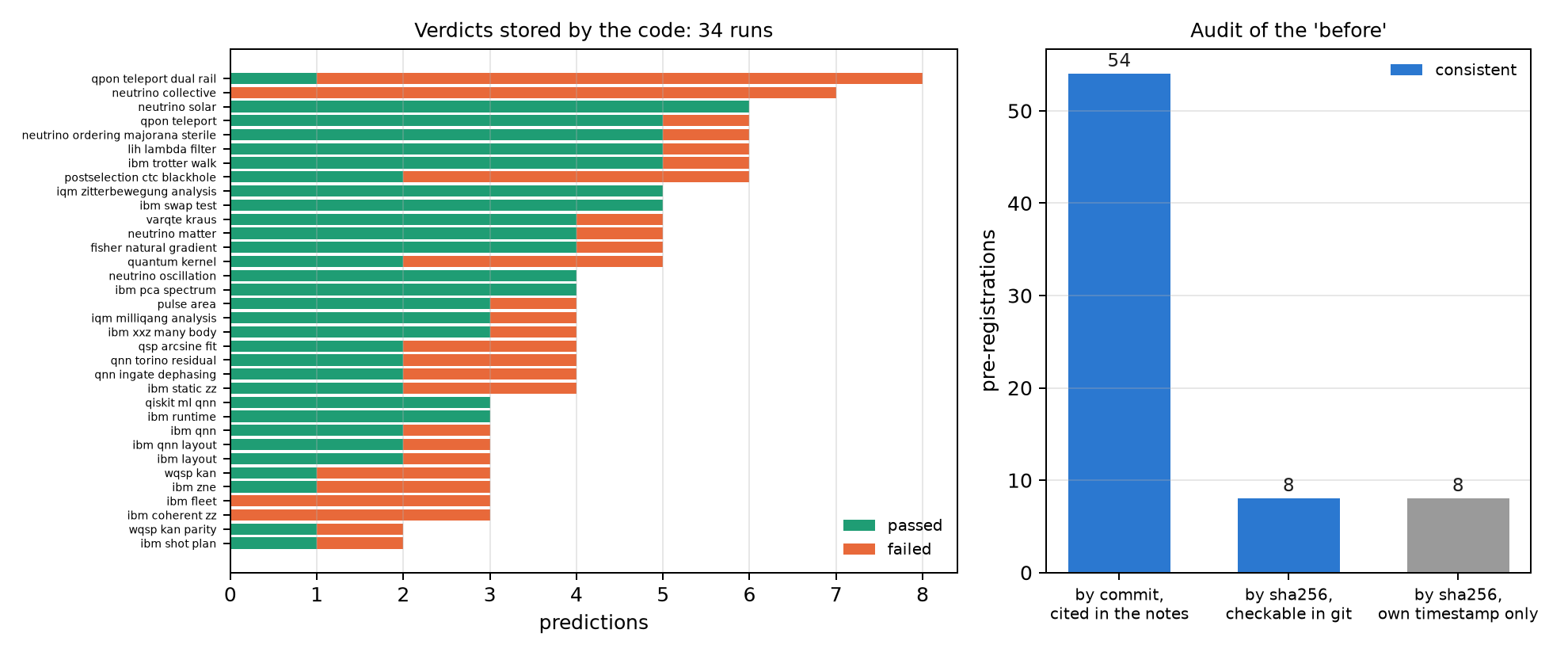
What the code stored. 34 runs leave in their results file a dictionary of verdicts computed by the script itself. The chapter’s script counts them: 148 predictions, 94 passed (64%) and 54 failed. Three runs failed all their predictions (the IBM fleet, the coherent ZZ and collective neutrinos) and seven passed all of theirs, among them \(E=mc^2\) on IQM Garnet (§170).
The QML line. For §75–§123, the repository’s README keeps another tally: 176 predictions judged, 123 passed and 53 failed, with 4 more waiting for the IonQ hardware run. The two counts are separate bookkeeping that partly overlap, and must not be added.
What cannot be recounted automatically. The sections before §71 barely use pre-registration, and many later ones record their verdicts only in prose (“Four passed; V1 failed”), with varied wording. A full count over §1–§170 would have to be done by hand, section by section. This book does not do it: it gives the two counts that can be checked.
A 64% hit rate is not a weakness. A rate near 100% would signal thresholds that are too soft. Several failures were the most informative results in the notes: the coherent ZZ that the filter does see (Chapter 27), the erasure rule that had to be fixed with \((1-h)\) (Chapter 26), the qg_YY metric that helps less than predicted (Chapter 23).
28.4 Audit of the “before”
That a prediction was written “before” has to be checkable. The script checks it with git:
- By commit (54 citations, §71–§165): every cited commit exists in the history and, at that commit, the notes do not yet contain the section’s results. All 54 are consistent.
- By sha256 (16 files): no script matches its hash today, as expected, because after the run the findings are added to its opening comment. The question is whether any stored version matches.
- In 8 of 16, the hash matches the script at the commit that added the
.prereg, and that commit is earlier than the results’. The “before” is checked. - In 8 of 16, the
.preregand the results came in the same commit, and no version of the script stored in git matches the hash: the script was frozen, run and edited before anything was pushed. For those eight the “before” rests only on the file’s own timestamp, which the author could have written at any time.
- In 8 of 16, the hash matches the script at the commit that added the
The eight are: neutrino matter and oscillation, mass ordering and steriles, solar neutrinos, post-selection and CTCs, pulse area, the quantum kernel and VarQTE. Their results are not false because of this; their pre-registration cannot be checked by a third party. The fix for what comes next is simple: push the .prereg and the frozen script in a commit of their own before running.
28.5 Testbeds
Nearly all the book’s results come from simulations with calibrated noise models, not from hardware:
- IBM: qiskit-ibm-runtime’s models with real published calibrations (Brisbane, Sherbrooke, Torino, Fez and a fleet of 21), run locally in Aer or in IBM Runtime’s local mode (§137, §144).
- IonQ: the cloud simulator with the Aria-1 and Forte-1 noise models, free (§20, §38). Without dominant T1: the mean readout does not move (+0.004 and +0.007, consistent with zero), the opposite of the IBM model.
- IQM: the simulated Apollo and Garnet models, used as a free rehearsal before every real run.
A calibrated noise model is not a device: it has no thermal population (Chapter 27), no drift, and none of the ways the vendor’s software batches circuits. That is why the book calls “simulated” everything that did not run on hardware.
28.6 Real hardware
- IonQ Forte-1 (§128): the predictions for H\(_2\) with the filter were pinned by commit and the simulator rehearsal met them, but the vendor refused the first submission before accepting the job (the project did not have that QPU enabled). Nothing was charged and there is no data.
- IQM Garnet, three-flavour neutrinos (§165, 8 circuits of 300 shots): the script rescores the four checks from the stored run, and all four hold. The error falls from 0.0615 to 0.0386 (1.59 times) and 88% of the shots are kept. With the filter the survival minimum sits at 2.6 GeV (exact 2.63); without it, at 0.8 GeV.
- IQM Garnet, the milli-qang (§168, 26 circuits of 4000 shots on one qubit): three of four predictions held. The script recomputes the X-gate cost with a single slope: 1.64 m-qg per gate (\(\chi^2/\text{dof}=0.81\)). Prediction M2 failed: the ten equator copies scatter half as much as binomial noise allows (ratio 0.50). It remains open.
- IQM Garnet, \(E=mc^2\) as a reading (§170, 24 circuits of 2000 shots on the same qubit): the pre-registration was pushed in its own commit before the job, as the fix of Section 28.4 asked, which is why it is the eighth checkable sha256. All five predictions hold (Section G.6), with a 26–71 m-qg gate bias reported in the open.
The three IQM runs are the project’s first real-hardware data, and Chapter 31 treats them in detail. A replication of §168 on five qubits and two days is prepared but not pushed to the repository, because at full size it would cost about 80 credits, and about 5 are left after §170 (estimated).
The \(\mathrm{Var}_\theta(F_{\text{echo}})\) criterion. The index announced a QPU falsification criterion based on the variance of the inversion echo over continuous trajectories. It is not defined anywhere in the repository, so the book does not use it. It remains an unwritten proposal.
28.7 Without qang and with qang
This chapter does not compare the qang scale with something else: it compares working without pre-registration with working with it.
| action | without pre-registration | with pre-registration | difference |
|---|---|---|---|
| decide whether a result helps | decided after seeing the data | threshold fixed beforehand, in m-qg or in ratios | in favour: 54 of 148 predictions failed and were published |
| report failures | omitted or reinterpreted | reported with their numbers (94/54, 123/53) | in favour |
| check the “before” | impossible | by commit: 54 of 54 checked; by sha256: 8 of 16 | in favour, with 8 cases unverified |
| rehearse before spending | — | free simulator with the same predictions before every QPU run | in favour: IonQ’s refusal cost nothing |
| pin the script by sha256 | — | only checkable if the .prereg is pushed before the results |
none in 8 cases: the procedure must be fixed |
Balance. Pre-registration worked: it kept failures in view and could be checked in 61 of 69 cases. The other 8 show a defect of the procedure, not of the result, and already have a fix. The lesson holds for the whole book: a figure without its prior threshold is not evidence, and a prior threshold that cannot be checked is not entirely evidence either.
28.8 In code
import hashlib, subprocess

h, path = open("examples/data/iqm_neutrino_qg.prereg").read().split()[:2]
c = "a74c07c5"                                     # commit that added the .prereg
frozen = subprocess.run(["git", "show", f"{c}:{path}"], capture_output=True).stdout
hashlib.sha256(frozen.replace(b"\r\n", b"\n")).hexdigest() == h   # True: this is the frozen script
28.9 Summary
- Predictions were pinned by commit (§71–§165) or by the sha256 of the frozen script.
- The 34 runs that store verdicts add up to 148 predictions: 94 passed and 54 failed; the QML line (§75–§123) records 123 and
- A full count of §1–§170 would have to be done by hand.
- The “before” is checked for the 54 predictions pinned by commit and for 8 of the 16 sha256 pre-registrations; for 8 there is only their own timestamp.
- Nearly everything is simulated with calibrated models. Real hardware is three runs on IQM Garnet: neutrinos (4 of 4), the milli-qang (3 of 4, with 1.64 m-qg per X gate) and \(E=mc^2\) as a reading (5 of 5, §170).
- The \(\mathrm{Var}_\theta(F_{\text{echo}})\) criterion does not exist in the repository and is not used.
Bibliographic notes
The falsification criterion is that of Popper (1959), and pre-registration as a practice, Nosek et al. (2018). The numbered research notes (§) cited in this chapter and the scripts that check it are in the repository (Monteverde 2026a); the definition of the qang unit is in Monteverde (2026b).